
Table of Contents
- Common Causes of Tripped Breakers
- Common Causes of Tripped Breakers
- How to Reset a Tripped Circuit Breaker
- Circuit Breaker Keeps Tripping After Reset: What to Do
- Signs of a Bad Circuit Breaker
- AFCI vs. GFCI: Breaker Types That Trip Differently
- When to Call a Professional Electrician
- Preventing Future Trips: Maintenance and Load Management
- Frequently Asked Questions
Last Updated: September 24, 2026
Common Causes of Tripped Breakers
A circuit breaker is a safety switch inside your electrical panel that cuts power when current flow gets too high. When circuit breakers trip, they are doing their job: stopping heat that could start a fire. According to the U.S. Fire Administration, electrical failures spark thousands of home fires each year, so that shutoff matters more than most people realize.
Most trips fall into one of these buckets:
- An overloaded circuit pulling more amps than it can handle
- A short circuit or ground fault sending current where it should not go
- A faulty appliance or worn wiring insulation causing repeated faults
A breaker that trips once and resets cleanly is normal. A breaker that trips again within minutes is telling you something is still wrong.
Common Causes of Tripped Breakers
Overloaded Circuits
An overloaded circuit happens when you plug too many devices into one circuit. The total electrical load exceeds the amperage capacity of the breaker, so it shuts off.
Signs of an overloaded circuit include:
- Breaker trips when several appliances run at once
- Lights dim when the fridge or AC kicks on
- The panel feels warm near that breaker
Short Circuits and Ground Faults
A short circuit occurs when a hot wire touches a neutral wire. A ground fault happens when a hot wire touches the ground wire or a metal box. Both cause a sudden surge of electrical current, and the breaker trips instantly.
- A burning smell near an outlet or switch
- Scorch marks or melted plastic
- A popping sound when you plug something in
Faulty Appliances and Damaged Wiring
Sometimes the breaker is fine and the appliance is the problem. A faulty appliance with damaged internal wiring will trip the breaker every time it runs.
How to Reset a Tripped Circuit Breaker
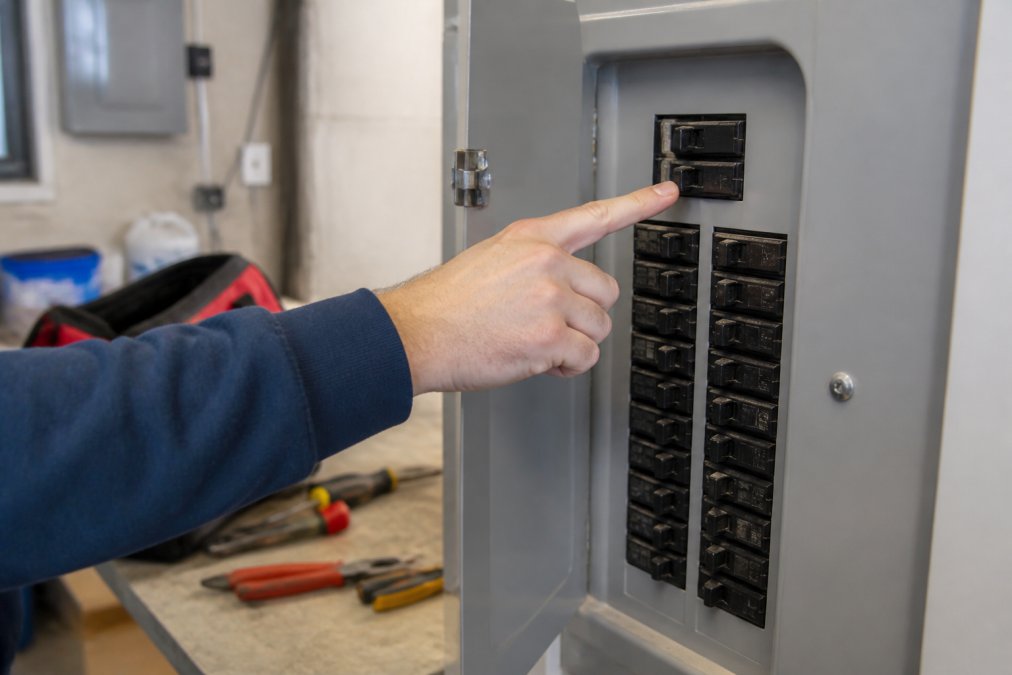
Resetting a tripped breaker is safe when you follow the right steps, but the procedure changes depending on which type of breaker tripped. Standard, GFCI, and AFCI breakers all reset differently, and using the wrong motion can leave a breaker that looks ON but is still dead.
Before You Touch the Panel
- Stand on a dry surface and keep both hands free, no wet floors, no leaning on a sink or appliance.
- Use one hand only. This keeps current from crossing your chest if something goes wrong.
- Never stand in water or on a damp basement floor.
- If the panel feels warm, smells like burning, or shows scorch marks, stop. Do not reset it. Call a licensed electrician.
Standard Breaker Reset (Step by Step)
- Turn off and unplug devices on that circuit.
- Open the panel door and find the tripped breaker, it sits between ON and OFF, not fully off.
- Push the switch firmly to OFF first. This resets the internal mechanism.
- Then push it firmly to ON. You should feel and hear a solid click.
- Check whether power returns to the circuit.
- Listen for popping, buzzing, or a burning smell. If any appear, shut it off and stop.
That middle position is the giveaway. A tripped breaker rarely looks ‘off’, it sits halfway, which is why people miss it.
GFCI Breaker Reset
A GFCI breaker has a small TEST and RESET button on the breaker face (or on the outlet itself). After a trip:
- Press RESET firmly. If it holds, power returns.
- If it will not reset, press TEST first, then RESET.
- If it still will not hold, the ground fault is still active, often moisture in an outdoor outlet, a bathroom receptacle, or a kitchen counter circuit.
AFCI Breaker Reset
An AFCI breaker has a TEST button and a RESET procedure similar to GFCI, but it trips on arc signatures, tiny sparks from damaged wiring or loose connections. If your AFCI will not hold after a reset, the wiring itself is suspect. Do not keep resetting it. That is a job for a licensed electrician.
| Breaker Type | Reset Motion | If It Won’t Hold |
|---|---|---|
| Standard | OFF, then ON | Fault still active on the circuit |
| GFCI | TEST, then RESET | Moisture or ground fault present |
| AFCI | TEST, then RESET | Damaged wiring or loose connection |
Never tape or hold a breaker in the ON position to stop it tripping. That defeats the safety switch and can overheat the wiring behind your walls.
Label every breaker in the panel before you need to reset one in the dark. A sharpie and ten minutes now saves a flashlight-and-guessing session later.
Circuit Breaker Keeps Tripping After Reset: What to Do
If your circuit breaker keeps tripping after reset, the fault is still active. Do not keep flipping it. Each reset sends current back into a problem you have not fixed yet, and repeated resets can turn a small fault into a fire.
Step 1: Isolate the Circuit
- Unplug every device on that circuit, including things on power strips and anything plugged into outlets you forgot about.
- Turn off any hardwired loads on that circuit (disposal, dishwasher, built-in microwave).
- Reset the breaker once.
Step 2: Read the Result
If the breaker holds with nothing plugged in: the wiring is likely fine and a device is the culprit. Move to Step 3.
Step 3: Add Devices Back One at a Time
Plug devices back in one at a time, running each for a minute or two before adding the next. The device that trips the breaker is your answer. Replace it or have it repaired.
Step 4: Match the Trip Pattern to the Cause
| Trip Pattern | Likely Cause | Fix |
|---|---|---|
| Trips when several appliances run at once | Overload | Spread loads across circuits |
| Trips instantly when a device is plugged in | Short circuit | Replace device or repair wiring |
| Trips in a bathroom, kitchen, or outdoors | Ground fault | Dry the outlet, check for water intrusion |
| Trips on an AFCI with no obvious load | Arc fault | Inspect wiring and connections |
| Trips with nothing plugged in | Wiring fault or bad breaker | Call an electrician |
Step 5: Run a Load Calculation Before Adding More
Modern homes carry far more steady draw than the panels were sized for. A smart thermostat, video doorbell, mesh Wi-Fi system, security hub, and a few smart plugs can add up to a meaningful continuous load on circuits that were never designed for it.
If you smell burning, see scorch marks, or hear popping when you reset the breaker, stop immediately. Those are signs of a short circuit or arc fault, not an overload, and they are a fire risk.
Signs of a Bad Circuit Breaker
A bad circuit breaker fails in predictable ways. The Occupational Safety and Health Administration treats electrical hazards as a leading workplace danger, and the same warning signs apply at home.
Physical Warning Signs
Watch for these:
- Flickering lights on one circuit only
- A burning smell from the panel
- The breaker feels hot to the touch
- Visible scorch marks or burnt wiring
- The breaker will not stay in the ON position at all
Any of these means the breaker itself may be failing. A worn breaker can stop tripping when it should, which removes your main protection against overheating.
AFCI vs. GFCI: Breaker Types That Trip Differently
AFCI and GFCI breakers protect against different dangers, so they trip for different reasons. Most guides skip this, but it changes how you troubleshoot.
| Breaker Type | Protects Against | Common Trip Cause |
|---|---|---|
| Standard | Overloads and shorts | Too many devices |
| GFCI | Ground faults | Moisture, water contact |
| AFCI | Arc faults | Damaged wiring, loose connections |
When to Call a Professional Electrician
Call a professional electrician when a breaker trips with nothing plugged in, when you smell burning, or when you see scorch marks. These point to wiring faults inside your walls, not a simple overload.
Also call if:
- Your panel is old and trips often
- Breakers feel hot or will not reset
- You are adding an EV charger or major appliance
- You need a load calculation for smart home devices
Before adding a smart thermostat, security system, or EV charger, add up the amps each device draws. If the total pushes past 80% of your circuit capacity, plan for a panel upgrade.
Preventing Future Trips: Maintenance and Load Management
Prevention comes down to two habits: managing your electrical load and keeping up with maintenance.
Start here:
- Spread high-draw appliances across circuits
- Replace worn cords and damaged plugs
- Schedule a professional inspection every few years
- Upgrade old panels before they fail
- Label your breaker box so you can find circuits fast
Frequently Asked Questions
How do you fix a breaker that keeps tripping?
First, unplug all devices on that circuit and reset the breaker. If it holds, plug devices back one at a time to find the culprit. If it trips immediately with nothing plugged in, you likely have a short circuit, ground fault, or a failing breaker. Stop resetting and call a licensed electrician for a professional inspection.
How many times can a breaker trip before it goes bad?
There is no fixed number, but repeated tripping under normal loads suggests the breaker is wearing out. A breaker that trips every time you reset it, feels hot, or smells like burning plastic needs replacement. Frequent tripping also stresses wiring insulation over time. If your breaker trips more than a few times a month, schedule an electrical safety inspection.
Can a faulty appliance cause a breaker to trip?
Yes. Appliances with damaged cords, internal shorts, or worn motors draw excessive current and trip the breaker. To test, unplug the appliance and reset the breaker. If it holds, the appliance is the problem. If it still trips, the issue is in the wiring or the breaker itself. Faulty appliances are one of the most common causes of tripped breakers.
When should I be concerned about a tripping breaker?
Be concerned if the breaker trips repeatedly, if you see scorch marks or smell burning near the panel, if the breaker feels hot, or if lights flicker when appliances run. These signs point to overloaded circuits, damaged wiring, or a failing breaker. A licensed electrician can diagnose the exact cause and prevent fire hazards.